The Republican Dictionary As Necessary Today As It Was During the Bush Years
This was the website for the Republican Dictionary. The Republican Dictionary (RD) was created to document the highly skilled twisting of the English language by the Republican Party and the inevitable hypocrisy that comes with it.
Content is from the site's 2007 archived pages.
Enjoy an entertaining read and perhaps begin to understand what the Republicans were really saying in 2007.

about the republican dictionary
Ever wonder what President Bush means when he says "freedom is on the march?" Now you don't have to!
Party strategists have successfully modified terms like "family values", "bias", and "personal responsibility" in the minds of Americans from their basic literal meanings into campaign slogans or code words for specific policy positions of the Republican Party.
Who can doubt, for example, that the phrase "support the troops" has been so well controlled by Republicans that their political opponents hesitate to even utter this seemingly non-partisan phrase for fear of mimicking the Republican platform? This in turn makes it relatively simple for Republicans to accuse Democrats and Liberals of not caring about our soldiers, even as Republicans cut funding for veteran's benefits and military housing.
At the very least, such language-crafting is a means to increase public support for Republican policies by describing them with deceptive terms. At most, it is a campaign to modify the English language to have favorable terms be synonymous with Republican policies and negative terms be labels for the opposition (call it Newspeak?). For example, the term "compassion" recently began its redefinition in the 2000 presidential campaign with George W. Bush's platform of "compassionate conservatism". And who could forget Donald Rumsfeld gushing about the "humanity" of the U.S. military's latest death-dealing technology at the outset of the Iraq War? Oh, the humanity!
Central to this campaign is the deliberate targetting of political messages directly into the emotional subconscious and the reactionary reptilian brain in order to circumvent critical thinking and more easily manipulate the American people into holding ludicrous and often contradictory beliefs (call it doublethink?). As master Republican language crafter Frank Luntz said: "80% of our life is emotion and only 20% is intellect. I am much more interested in how you feel than how you think."1
Among other things, Luntz can be credited with advising Republicans to call the estate tax the "death tax", change "global warming" to "climate change", "tax cuts" to "tax relief", and refer to the war in Iraq not as the "War in Iraq", but as the "War on Terror". These and other simple language adjustments serve to modify public opinion for policies as needed without actually modifying the policies themselves. Hmm, Iraq? Why would we start a war with them? They had nothing to do with 9-11. Oh, wait - You say it's the War on Terror? Count me in!
Similarly, when the Bush Administration decided to push an anti-terrorism law enforcement act through Congress, it was not called the Anti-Terrorism Law Enforcement Act. Such an accurate and honest description might have caused Americans to wonder how law enforcement activites would be modified in order to fight terrorism, and perhaps feel the need to know its contents.
Instead, the Justice Department called it the USA PATRIOT Act, appealing to our national pride and desire to support our country, and slam-dunked it through Congress and the American people without hardly anyone even reading it. Easy as pie. And if someone decided to read it, or even worse - gasp! - criticize it, they must not be patriots! Yes that's it - they hate America! The subsequent VICTORY Act, PROTECT Act, No Child Left Behind Act, and other government initiatives continue this trend, not the least of which being a war sold to the American people as a necessity to disarm a dictator called "Operation Iraqi Freedom".
With such a simple and powerful tool at the government's disposal, why stop at simply starting wars and passing laws? Why not amend that irritatingly secular Constitution to make it more consistent with the right-wing brand of Christianity? In order to institutionalize discrimination against homosexuals in America's most sacred legal document, a constitutional amendment designed to prevent homosexuals from getting married would not be called the Anti Homosexual Marriage Amendment. With that label, many people might get the unfortunate impression that American citizens should have equal protection under law regardless of their sexual orientation.
Therefore, it is called the Defense of Marriage Amendment. With such an appeal to the reptilian brain, Americans are frightened into thinking that same-sex marriage is some kind of an attack on their own, and so they must act to prevent evil homosexuals from destroying their family. Bar the doors, Honey! The homos are coming to tear us apart!
In the near future, perhaps we can expect initiatives like the HAPPY CHILDREN Act to slash funding for public education, the War On Evil and Bad Stuff to invade Canada and privatize their water supply, and the Super Duper Freedom Increasing Amendment to prohibit public demonstrations against government policies. After all, you don't hate freedom, do you?
Typical 2007 Articles
articles
OPINION
Elites, Thought Providers, and Rabble Irregulars: The One-Sided Class War in Modern America
Given this multi-faceted campaign of Elites enriching themselves at Rabble expense, how are Rabbles kept under control? Rabbles are the great majority of Americans; Elites are but a tiny minority. How do the Elites keep their class war one-sided and prevent rebellion?
The answer lies with the most important weapon the Elites have: The Thought Providers ...
RESEARCHED: The Bush Administration Record
President Bush and the War on Terror
The actions of the Bush Administration before and after September 11, 2001, and the selling of the Iraq War.
President Bush and Foreign Policy
The destruction of the United States' respect in the civilized world and the loss of global stability through reckless arrogance and a lust for war.
President Bush and the Environment
The rollback of decades of environmental and health protections and the endangering of our future through willfull ignorance and shameful political payback.
President Bush and the Economy
The bankrupting of the federal government and the restructuring of the national economy for the benefit the rich.
RESEARCHED: Bush Administration Profiles and Background
George W. Bush, Background and as Texas Governor
The unlikely and mediocre rise of George W. Bush, his environmental and education record as Texas governor, and the troublesome election of 2000.
Dick Cheney and the Business of Government
The ethically questionable business background of Halliburton CEO Dick Cheney, and his continued role as Vice President to increase the stock value of his professional friends.
Donald Rumsfeld, the United States, and Iraq
The twisted global vision of Donald Rumsfeld and a short history of U.S.-Iraqi relations before and after the first Gulf War.
John Ashcroft and the War on American Freedom
A brief background of John Ashcroft and the systematic and deliberate dismantling of our constituional freedoms under his direction.
The Project for the New American Century
What is the Project for the New American Century? Learn about this Washington insider organization and its ideological influence in the White House and the Pentagon. And you thought we went into Iraq because of WMD?
SATIRE
Intelligent Design challenged by other movements
... With no less than an endorsement by President Bush, proponents of intelligent design have had success in their campaign to introduce the theory as an alternative to evolution in science classrooms ... In response, proponents of theories like "cognizant origination", "spontaneous generation", and "sentient concoction" are lobbying for their views to be taught as science to students in many communities across the United States ...
(This article appears as a BBC article, but it is not.)
Karl Rove dies, Satan's approval rating hits record high
... Soon after Rove's death, a poll taken of over 1,000 condemned souls in the Unholy Kingdom of Hell showed that 51% of Hell's residents approve of the way Satan is handling his job. This is the first time in the history of Hell that Satan has enjoyed a majority approval rating from his subjects ...
(This article appears as a BBC article, but it is not.)
Bush administration makes case for attacking sun
Bush administration officials are ramping up their criticism of the sun in an attempt to secure public support for a military strike against the class G2 yellow star at the center of our solar system ...
(This article appears as a BBC article, but it is not.)
News Dispatch From 2032
An abnormality in the sun's gravitational field Thursday resulted in a small portion of an American news program from the future to be received by several television sets in Ciudad Acuna, Mexico and Del Rio, Texas. The program appears to originate from the year 2032. The following is a transcript ...
Justice Department Introduces MOM AND APPLE PIE Act
With the success of the PATRIOT Act, the PROTECT Act, and the VICTORY Act, President Bush and conservative lawmakers are hailing the introduction of the Justice Department's MOM AND APPLE PIE Act of 2003 ...
RESEARCHED SATIRE
Meet the Liars
An unprecedented number of high-ranking officials from the Bush Administration and the intelligence community have publicly or anonymously criticized Bush's handling of the terrorist threat, and some go so far as to suggest Operation Iraqi Freedom is a war fought on deception by the Bush Administration. Let's meet just a few of these liars ...
Fox News is Fair and Balanced
Fox News is so fair and balanced that its viewers are the most uninformed people in the country, and coincidentally, most likely to support President Bush. This happens to coincide with the idea that "nothing" (definition) is indeed a principle worth fighting for. The great philosophers can argue both for and against the existence of God with the same accepted facts.
Support the Troops!
How is President Bush supporting the troopsTM? And what do some of the troops think of this support and the Iraq War itself?
Republican Electrons Deserve Right to Vote
In addition to coursing through wires to power the voting machines, these patriotic electrons are known to consistently support Republican candidates in elections across the country where Diebold and ES&S; voting machines are used. For this reason, Liberals are doing everything they can to shut them out of the electoral process ...
Hello, and welcome to the Republican Dictionary. We hope you find this to be a valuable resource in understanding Republican talking points, State of the Union speeches, and mainstream media coverage of current events. Click on a letter above to browse the dictionary.
Right-wing embarrassment is actually a victory
The recent embarrassment (that is, if they are capable) of the right-wing blogosphere over their invented controversy about a recent AP story is actually a chilling and gruesome victory.
In November, the AP reported a story, citing an Iraqi police officer named Hussein as a source, that six people were shot and burned at a Sunni mosque in a particularly ghastly incident of the sectarian violence occurring in Iraq. The U.S. Military and Iraqi government initially raised doubts about this supposed Hussein and the right-wing blogosphere used those doubts as a launching pad for their lunatic journey into the conspiracy theory that the AP had invented Hussein as a means to spread false information about the conditions in Iraq.
This is just what the right-wingnuts have needed for years - proof, even if derived from only one report among thousands, that everything in Iraq is going just dandy and that all the negative reporting is a product of liberal terrorist-loving bias and outright lies.
Just yesterday, however, the Iraqi government not only stated that this police officer does in fact exist, but that he might be arrested for speaking to the press without authorization.
One might think the right-wing blogosphere would suffer a propaganda defeat with a solid debunking of their most precious story. But the message it sends Iraqis is different than the message it sends us here sitting safely at our computers in the United States. While we chuckle at yet another incident of the wingnuts whipping themselves into a frenzy over something that they essentially pulled out of their ass, Iraqis who would've felt tempted to speak to reporters might now instead feel more inclined to keep their mouths shut for fear of being exposed.
That is the message sent by the right-wing blogs: If you speak to the media without government authorization, we will not rest until you are found and arrested. If you fail to conform to the government-approved narrative of an Iraq getting better and better everyday with the promise of stable democracy, we will hound the press until you are exposed and placed in danger from retribution, possibly in the form of torture and murder, from militia groups you might have angered with your statements.
The right-wing blogosphere should be patting themselves on the back for sending out a warning to Iraqis: Keep your goddamn mouths shut and look happy for the cameras.
Edwards gets off to a Bushy start
Nice going, John. Just when we thought George W. Bush was the king of photo-ops, what do we get to see when one of our favorite presidential hopefuls announces his run? You, wearing blue jeans and shoveling dirt with some - surprise! - young black guys. Note to John: The tough workin' man look would have been more effective if you weren't wearing your blackberry.
Don't get us wrong, we're aware of the unfortunate fact that in product advertising, images are frequently more important than words (you being the product). But your campaign team doesn't seem to know the difference between effective stage decorations and a blatantly fake photo-op. You see, this is the kind of thing we liberals (your potential base) are so sick of seeing for the past six years. For us, such crafted images like these are indicative of a politician who puts image before substance and who thinks his target audience are a bunch of morons.
We're not morons. When we saw George W. Bush get out of a freakin' navy jet in a flight suit, we hurled. When we saw him trimming brush on his fantasy camp ranch and practically tripping over his own cowboy boots, we laughed our asses off. And when he commandeered a group a firefighters for the sole purpose of posing with them with his sleeves rolled up after Katrina, we got pissed - really pissed.

Some in your campaign team may struggle with the difference between effective imagery and ridiculous photo-ops, and the line between the two isn't exactly crystal clear. But here's my best guess as to one of the basics: When you are actually fabricating events for the sole purpose of having pictures taken of them, you're crossing the line. We all know George W. Bush is not a pilot, he doesn't work on his ranch when cameras aren't present, and he wasn't about to go save people from a burning building after the hurricane.
And yes, we know this shoveling business wasn't for real. It's only for show - everyone knows it and it makes you look stupid. We won't be voting for you for your shoveling technique - we'd be voting for you for your policies designed to prevent another community from being buried in the first place.
We'll tolerate you posing in front of monuments and flags. We won't even mind too much if you find some "Made in the U.S.A." boxes for a backdrop like Bush did, but unless you plan on switching parties and battling McCain for the Republican nomination, don't insult our intelligence. If you want our vote, John, you're going to have to get real, and fast.
The latest insight into the brain of George W. Bush
"I've got so much on my mind, and this job is so exciting that it's really hard to settle down and plan the next 10 years of our life."
People's interviewer also mentioned that readers had asked if he takes sleep aids. Bush said generally not, but he does occasionally when he travels.
"I must tell you, I'm sleeping a lot better than people would assume," he said.
He said he drinks a couple of cups of coffee in the morning and drinks a lot of water and, of course, no alcohol.
"I don't drink alcohol. I can remember when I used to drink, I had trouble sleeping at night," the President said.
Click on the thumbnail to enlarge.

Republicans dust off their "box turtle"
Newly elected Congressman from Minnesota and muslim Keith Ellison prefers that he take the Oath of Office with the Quran instead of the Bible. This seems like a non-issue in a society that cheers freedom of religion as a central tenet of our national character. And, of course, it happens to be in the First Amendment of that pesky Bill of Rights. But predictably, right wing champions such as Sean Hannity and Dennis Prager are doing their best to help us understand that freedom sounds good on paper, but practicing it is dangerous.
In the video linked below at C&L; you will see Sean Hannity warn that allowing officials to swear on the Quran could lead to someone wanting to swear on Hitler's Mein Kampf! This is because Hannity is incapable of defending his weak opinion that Ellison should not be allowed to swear on the Quran, so he instead changes the argument completely from the actual to the hypothetical in order to artificially weaken his opponent's position into one of defending the use of Hitler's infamous manifesto instead of a perfectly legitimate holy book of a religion held by billions of people.
This is one of the standard debate tactics used by right wing pundits when they know their argument is weak and must therefore change their opponent's position into one even weaker than their own using dishonest hypotheticals.
It's the same with Tucker Carlson and his famous argument that allowing same-sex marriage could lead to people wanting to marry box turtles. Carlson can't defend his position with reason and logic, so he demands that supporters of same-sex marriage defend the marriage of people to box turtles instead. He ends up looking reasonable in comparison.
Unfortunately this tactic usually works. As you can see, Hannity's guest, Mr. Shabazz, tries to deflect the analogy with a brief comment, walking right into Hannity's trap and prompting Hannity to jump on Shabazz as if he were ducking a legitimate question. This effectively put Shabazz on the defensive with a verbal sleight-of-hand when before he had the clearly stronger position in a no-brainer of an issue.
Bon Appetit!
Steve Sack is a bottomless well of cartoon genius.

Karl Rove Jumps the Shark
We have finally seen the inevitable failure of the Rovian strategy
The words "attack, attack, attack" have been uttered by many to describe the central tenet of Karl Rove's campaign strategy. He never plays defense, no matter what comes his way. If his candidate is attacked, he responds with a stronger attack. If his opponent has an edge on the issues, he never attempts to bolster his candidate's positions, but instead attacks his opponent with personal smears and dirty tricks. This strategy has worked with tremendous success in the past, but has finally met its inevitable fate.
If the game of politics can be described with war metaphors, which it is by pretty much everybody, then a strategy built around "attack, attack, attack" can be equated with constantly moving the front line forward, never retreating or holding position. This "front line" of Rove's has been constantly moving forward for the past six years, and in the literal world means that the Republican Party's political rhetoric has gotten stronger and stronger to the point of finally jumping the shark into the realm of mind-blowingly ludicrous.
A few years ago, Republican politicians would never have gone so far as to suggest that Democrats want the terrorists to win. Such allusions would have been considered highly offensive and way beyond the pale. But Karl Rove and his lieutenants kept moving their front line forward until we finally saw what would eventually rear its ugly ass: Republicans openly and with a straight face practically accusing the Democrats of working in concert with the terrorists to achieve their shared agenda of attacking American values. Orrin Hatch said the terrorists were laying low and hoping for a Democratic victory in order to strike, Donald Rumsfeld said that the terrorists in Iraq were increasing their violence in order to help the Democrats win elections, Dick Cheney equated the likely Democratic win to the terrorists successfully breaking the will of the American people, and every Republican from sea to shining sea clung desperately to their Rovian talking points designed to suggest that Democrats are cowards who want to surrender to Al Qaeda.
There is a depressingly large percentage of stupid, gullible voters in this country who will believe every talking point fed to them by Fox News and Clear Channel and obediently given the legitimacy of equal time by the rest of the mainstream media. Karl Rove knows this more than anybody. But his tactics unintentionally caused many of these otherwise stupid people to have moments of clarity. Can't you just picture it: The loyal Sean Hannity fan driving in his car and considering for a moment how ridiculous it is for someone to suggest that the majority of Americans who criticize the war rejoice at the deaths of U.S. soldiers and want nothing more than terrorists to come to the United States and kill innocent people. Maybe this moment of clarity opened up this guy's mind to different opinions, or maybe it simply caused him to skip the long lines on Election Day and go straight home.
The Democrats didn't so much win this election as allow the Republicans to lose. The Republican attack, attack, attack strategy finally became predictable for them, so they simply opened their ranks and allowed the Republican front line to march right on through and then jump over the cliff that always seems to be at the Democratic Party's feet.
Hopefully the Democrats will learn from this. They were smart enough not to defend themselves against the more ridiculous attacks by claiming that they do not in fact chuckle over their lattes whenever a U.S. soldier is killed by a terrorist. They did respond however, as they must no matter how baseless the charge - a lesson they should hold dear after the Great Swiftboating of 2004, but they were most effective when simply pointing out how insane the Republican political messages had become. With their latest national campaign ad, the Republican Party has become the largest distributor of Al Qaeda video propaganda in the United States hoping to accomplish with it what the terrorists do: scare the shit out of as many people as possible with the goal of inhibiting rational thought and bending them to their will. But just like Americans stood up fearless against the terrorists after 9-11, yesterday we stood up fearless against the Republican Party's fear campaign and said, "Fuck you, I am not afraid."
Sun Tzu taught that you should never allow your enemy safe ground, hit him where he is most unprepared and appear where you are least expected. Thanks to Howard Dean and his insistence on a fifty-state strategy, we not only know this to be effective politics, but we also know that there are millions of voters everywhere who are begging for an alternative to this garbage and who would cast their vote accordingly if only someone would politely ask for it.
Graphic: 1776 and 2006
Click on the thumbnail to enlarge.

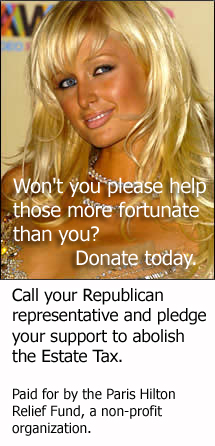
Please find it in your hearts to help the victims of progressive tax policy
(Steal this graphic)
A couple responses to less than stellar opinion pieces from the Right
First, Wal-Mart Drives Democrats Batty by National Review Online's Brainiac At Large Jonah Goldberg, who borrows the tired use of "Bush haters" to craft "Wal-mart haters" as a means to characterize Wal-mart critics as blindly irrational crybabies. This article is particularly stupid. I highly recommend it.
Response:
Dear National Review,
I am concerned for the perceived relevance of NRO regarding your news organization's retention of the services of Jonah Goldberg. His latest article, Wal-Mart Drives Democrats Batty, is proof of Mr. Goldberg's lack of vigilance in participating in the Republican Party's most current political machinations. Supporting such incompetent leaders requires constant adaptation, and "Bush-haters" is so 2003.
This particular political manipulation certainly had its value. If you can effectively characterize critics of the Bush administration as simply having a mental illness, you can discredit everything they say without offering a rational counter argument. After all, why argue with them? They're crazy!
Nonetheless, this talking point has come and gone, despite Mr. Goldberg's best efforts to assist President Bush, who, if poll numbers are any indication, is apparently a rather lonely sane man living in a nation populated by a majority of crazy people. But Goldberg has also decided to lend this particular method of manipulation to his hero of the poor, Wal-Mart.
Mr. Goldberg is certainly an intelligent man; I doubt NRO would publish his work otherwise. But perhaps a consideration of Wal-Mart beyond a brief perusal of the corporation's own website would assist Mr. Goldberg in understanding why an increasing number of Americans are falling under the influence of "Wal-Mart Derangement Syndrome."
If I were under such influence, and hence unable to form rational thought, I might actually wonder how Wal-Mart is able to sell products for such cheap prices. Just in case Mr. Goldberg reads this, I will make the case brief in order not to offend his short attention span due of course to his highly intelligent and active mind.
Wal-Mart is a colossus of American retail who can use its influence to force producers to sell their products to Wal-Mart at cheaper and cheaper prices. In any business, the highest operating costs are payroll. Therefore Wal-Mart is taking part, albeit indirectly, in the falling American working-class wage. And since Wal-Mart can address nearly all purchasing needs of a community at cheaper prices, local businesses are doomed to fail when Wal-Mart comes to town. When local businesses fold, the profits for doing business no longer stay in the community, but are shipped to Bentonville, Arkansas. As a result, the economies of local communities are depressed as Wal-Mart works to realize its utopia - a nation of small communities in which everyone works at Wal-Mart, earns the small Wal-Mart wage, and can therefore only afford to shop at Wal-Mart.
Mr. Goldberg's unimaginative mind, perhaps stricken with Jonah Goldberg's disease, seems incapable of a train of thought longer than 5 seconds, which can only produce such simple conclusions as: Wal-Mart is cheap, therefore Wal-Mart is good for the poor.
I encourage NRO to more adequately review Mr. Goldberg's work before embarrassing yourselves further.
Yours,
Ian Watson
And 'Islamic Fascism': What's The Issue?, an article by Weekly Standard contributor Joseph Loconte defending the Bush administration's new creative use of the word fascism.
Response:
Dear Mr. Loconte,
In your recent article, 'Islamic Fascism': What's The Issue?, you fail to address the actual definition of fascism and whether or not it is correctly applied to Islamic extremists. This is the main contention with this new use of the word fascism, and not whether it hurts people's feelings as you imply.
The Nazi brand of fascism does indeed share a few traits with today's Islamic extremists such as its high degree of nationalism (of a sort) and its anti-liberalism and anti-individualism. But most surely agree that fascism is not fascism without strong elements of corporatism - a marriage of government and powerful moneyed interests, usually corporate.
This aspect of Hitler's fascism was attractive to many American business interests in FDR's day, and seems all but an unofficial aspect of our own government with the massive influence that corporations have in Washington through campaign funding, lobbying, and the revolving door of corporate personnel serving as government officials, most significantly displayed by Dick Cheney's adventure as Secretary of Defense, Halliburton CEO, then Vice President.
The application of the term "fascism" to the extremists of the Islamic world is grossly inaccurate and rightfully invites not only criticism, but questions about the motives behind this supposed attempt to redefine the word, especially when Donald Rumsfeld recently compared critics of the administration's Iraq war policy to Nazi appeasers.
I also take particular exception to your implication in the last paragraph (perhaps unintended) that critics of the Bush administration's use of the word fascism are somehow trying to minimize and ignore the threat of Islamic extremism. This is also incorrect.
Yours,
Ian Watson
Condi Rice's "Birth Pangs" is a Rapture reference
Condi Rice's infamous words on July 21, 2006:
"But I have no interest in diplomacy for the sake of returning Lebanon and Israel to the status quo ante. I think it would be a mistake. What we're seeing here, in a sense, is the growing -- the birth pangs of a new Middle East."
What a strange way to describe such extreme human suffering and violence. Then again, it turns out our Secretary of State isn't the only one to use "birth pangs" in such an interesting way. "Birth pangs" is a common term among End Timers to describe the turmoil that precedes the tribulation and rapture supposedly foretold by biblical prophecy:
From Pastor Ron Graff at Bible-prophecy.com:
BEGINNING OF BIRTH PAINS - Matthew 24:4-8
This is a picture of the times in which we are living. This is the generation which has seen the rebirth of the nation of Israel, exactly as prophesied in Ezekiel, chapters 36 and 37 ...
The events of this period of time are like the onset of labor pains. They are strong enough to let the mother know that the time of birth is near, but they are not as severe as they will be later. Thus, the dreadful events of the Tribulation are prefigured by many smaller versions of the same things before the intense trouble of the Tribulation actually begins.
From Tribulation Forces, Signs of the times and Bible prophecy:
There are two periods that Jesus taught about the end of times. During the first period we will experience the "birth pangs" , , and which are setting the stage, so to speak of things to come. The second period will be the actual "signs" of the end. Here are the "birth pangs" (again, NOT signs of the end):
- Israel becomes a country again. In 1948 Israel became a nation again for the first time in 1500 years.
- In 1967 after the 6-Day War, Israel regained control of Jerusalem.
- Many people will claim to be the Christ (the Messiah) Since 1900 alone there have been over 1100 public figures claiming to be Christ.
- Among them Sun Myung Moon, Maharaj Ji and countless others.
- People will be decieved by these fakers.
- Wars and Rumors of wars, revolutions. Since World War II there have been over 170 limited scope conflicts.
- Famines, earthquakes, pestilences. Billions of people go to bed hungry each night. Just view the happenings in Africa.
- The number of earthquakes has increased in both numbers and intensity within the last 30 years. From 1960 to 1979 there were over 64 earthquakes measuring over 6.0 on the richter scale. From 1980 to present there have been over 200. Compared to even the early 1900s when there was only 8 in a 30 year period.
- Nations and kingdoms at war. It seems that on any given day somewhere in the world there is an ongoing armed conflict.
From Rapture Ready:
The unending avalanche of catastrophes has convinced me that they are part of the end-time warning signs called the birth pangs. The Bible predicts they will increase in frequency as we get closer to the tribulation hour. I expect the world media will soon be covering new calamities in the coming months.
The birth pang factor is not the only end-time indicator at work today. Jesus told His disciples that apathy would also be the calling card of His return. In the Book of Mathew, the Lord repeated himself four times in the space of a few verses. He obviously was trying to make a point of how slothfulness will relate to the last days.
And from the Rapture Ready Forums:
Guess what folks: The birth pangs are still coming
pains(sic) are still coming. Some thought things had quieted down for now but it looks like we were just in a lull before the next hard contraction. With all that's going on is the world today, it looks like the rider on the white horse of Revelation is busy taking peace from the earth. Are we next. We seen a glimpse of it in N.O. Now its like a wild fire that's spreading over the earth as people seemly goes nuts.
From a piece called Eschatology, Different Rapture Views by Greg Rugh:
"Essential to this view is the division of the Seventieth Week into three major, distinct, and identifiable periods of time; The beginning of "birth pangs," the "great tribulation," and "the day of the Lord." Ibid. p. 223
And finally from Max Blumenthal's piece in The Nation, Birth Pangs of a New Christian Zionism, but he doesn't mention Rice's statement:
Brog's recently published book, Standing with Israel: Why Christians Support the Jewish State, expands his case for Jewish acceptance of evangelical political goals. Brog told National Review that his book has universal appeal and will help anyone to "better comprehend the birth pangs of what in time will be a very important alliance." The phrase "birth pangs" is clearly understood by evangelicals as a scriptural citation from Matthew 24, which refers to the apocalyptic struggle that will usher in the Second Coming of Jesus Christ.
And hits from Google just keep on comin'.
So, now the Bush administration has taken politically coded language to a new low by throwing a big, greasy bone out to the lunatics who are soiling their underwear at the prospect that we are witnessing the end of the world.
Steal this Act!
More and more, the people writing our nation's laws are not the lawmakers in Congress. It has become depressingly common for corporate lobbyists - and sometimes the Bush administration (Patriot Act)- to write our laws, which are then passed through Congress only as necessary formality.
Well if lobbyists can write laws, then so can we. I humbly propose a work in progress:
Right to Vote Act of 2006
An Act
To ensure the intent of the electorate of the United States of America is faithfully executed in all aspects of the electoral process. Be it enacted by the Senate and House of Representatives of the United States of America in Congress assembled,
(1) Every eligible American citizen who is registered to vote has a right to cast a ballot and to have said ballot counted according to his or her intent.
(2) Any action with the intent to suppress electoral participation directly or indirectly is a federal offense subject to prosecution. Actions such as disruption of "get-out-the-vote" drives and similar initiatives, prevention of voters from reaching polling stations, disruption of political party operations, disseminating false information in order to discourage participation in the electoral process, and any and all other methods with the intent to discourage and suppress voter participation shall be punishable by a fine of $100,000 per instance.
(3) The number of available, operational, and legal voting facilities in each electoral precinct must be directly proportional to the number of registered voters of said precinct. The voter wait time for any electoral precinct shall be no more than two hours. Each electoral precinct must monitor wait times and when a wait time of over two hours is calculated, said precinct must make available additional legal voting facilities as required to comply with law.
(4) All voting machines, ballots, and tabulation methods, electronic and/or otherwise, shall be approved and certified by independent, nonpartisan, scientific review, the entire process of which open to public review. Any instance of unauthorized machines, ballots, computer code, or other methods are punishable by a fine of $100,000 per instance, nulls the election affected, and requires another election to be held in its place in order to ensure compliance with law and voter intent.
(5) All polling stations must be attended by personnel trained and appropriately certified in the operation of the voting machines and methods of said precinct.
(6) Local and state governments and private business are subject to lawsuits by the public for any instance resulting in the disenfranchisement of a voter's intent. This includes erroneous denial of voter registration, miscalculated votes, illegal wait times at polling stations, illegal voting machines, ballots, and/or methods, and any and all instances resulting in a failure to accurately and legally count and record voter intent.
(7) All machines and methods must produce hardcopy records that accurately reflect the voter's intent. Said records shall be securely kept by each electoral precinct for no less than a period of ten years for each election. No less than ten percent of election results for each electoral precinct must be audited with a hand-count of hardcopy records in addition to previously approved tabulation method in order to ensure electoral integrity. The elections audited shall be selected at random by each electoral precinct.
(8) Any and all instances of noncompliance with the law described herein and the appropriate prosecution shall be a matter of public record.
I've already gotten suggestions to add criminal penalties and jail time for violations, and to require observers at polling stations. This is good stuff. Got a suggestion? Please email it to me. I plan to send this to my Congressman, Lloyd Doggett, every week until I get a meaningful response.
Just for More Fun: Twenty more signs that you might be a Bush Supporter
We here at the Bush Support Rehabilitation Clinic recently generated a list of twenty indicators of Bush Support, a degenerative mental illness afflicting millions of people in the United States. This list helped thousands in realizing their condition.
In an effort to provide greater assistance to the public health, the following are twenty additional indicators of this illness. As before, if you find yourself agreeing with a majority of these indicators, please seek help as soon as possible. And remember, if you don't get help with us, please, get help somewhere.
1. You think that liberals are to blame for the deaths of U.S. soldiers, and not the people actually killing them or sending them to be killed.
2. You find the death of unborn children abhorrent only when it is the result of a woman's choice and not when it is the result of environmental contamination, malnutrition, lack of prenatal healthcare, or the bombing of civilians.
3. You draw no conclusion whatsoever from the fact that prescription drug prices have risen for senior citizens since President Bush enacted the Medicare prescription drug plan.
4. You think liberals hate U.S. soldiers and want them to die.
5. You support the philosophy of checks and balances in government, but cannot think of any instance in which the Bush administration should be subject to checks or balances in this "time of war."
6. You think President Bush is fighting to protect your freedoms from terrorists, but are willing to give up your freedoms in order to fight terrorists.
7. You think that knowledge of Valerie Plame's status as Joseph Wilson's wife is the same as knowledge of her status as a CIA agent.
8. You believe that as a Christian in the United States, you are a persecuted minority.
9. The death of Israeli civilians at the hands of Palestinian militants or terrorists causes you to rage against the attackers, while the death of Palestinian civilians at the hands of the Israeli military causes you to rage against the liberal media for its anti-Semitic news coverage.
10. You believe that corporate executives care more about the condition of the working class than labor unions.
11. You don't understand the difference between being accused of terrorism and being guilty of terrorism, and therefore do not understand the need for due process in terrorism cases or the outcry against the torture of people who have never been convicted or charged of a crime.
12. You don't think the subjects discussed and the conclusions drawn at Dick Cheney's secret meetings with Enron and other energy industry representatives to form our nation's energy policy are any of your business.
13. You've never heard of the Office of Special Plans or the Project for the New American Century.
14. The name "Hillary Clinton" sends you into a vitriolic diatribe against the senator, yet you cannot identify any of her policy positions.
15. You despise Bill Clinton for not catching or killing Osama Bin Laden prior to the attacks of 9/11, but excuse George W. Bush for not catching or killing Osama Bin Laden prior to or after the attacks of 9/11.
16. In the Bible, you find no exception to the proclamation in the Book of Leviticus that it is an abomination for a man to lie with a man, but find a vast number of exceptions to the commandment "Thou shalt not kill."
17. You find yourself willing to devote yourself to protecting the well-being of unborn children, but uninterested in the well-being of children after they're born or their mothers at any stage.
18. You do not believe that falling middle class income and rising corporate executive compensation is class warfare against the working class, but do believe that mentioning this fact is class warfare against the rich.
19. You despise the liberal media for its constant lies and distortions, but believe any and all reports from the media that sets President Bush in a positive light.
20. You proudly display a bumper sticker to "support the troops," but consider discussions of inadequate body armor, strategy, veteran's benefits, and soldier pay to be nothing more than liberal whining.
Just for Fun: Twenty signs that you might be a Bush Supporter
Friends, you might be concerned that you are afflicted with Bush Support. We here at the Bush Support Rehabilitation Clinic have assembled twenty indicators of this degenerative mental illness. If you find yourself agreeing with a majority of these indicators, please seek help as soon as possible. And remember, if you don't get help with us, please, get help somewhere.
1. You believe that leaking the CIA status of Valerie Plame, a "NOC" working on nuclear proliferation issues, was a heroic act, while you believe that the publishing of Bush's SWIFT monitoring activities by the New York Times was treason, eventhough it was a matter of public record.
2. You believe that you will stop loving your husband or wife and get a divorce if the two gay dudes down the street are allowed to get married.
3. You have no problem with voting machines being made by private corporations owned and operated by Bush supporters who claim that their programming code may not be inspected by anyone, make it impossible to perform recounts, operate elections in such a way that they can be manipulated while leaving no evidence whatsoever, and that we should all just "trust them."
4. You believe that the Jack Abramoff scandal is a bipartisan controversy.
5. You believe that Mexicans are to blame for stealing your jobs when corporations export hundreds of thousands of manufacturing, textile, and service jobs to Mexico, South America, China, Taiwan, and India.
6. You believe that "everyone" thought Saddam had WMD prior to the Iraq War.
7. You believe that one day we will find the last terrorist on earth and kill them.
8. You believe that in a time of war, the President may search and seize without a warrant, may deprive persons of life and liberty without due process of law, may detain persons indefinitely without trial or counsel, and keep all these actions away from the review of Congress and the Judiciary.
9. You earn the minimum wage and applaud Republicans for rejecting proposals to raise it.
10. You blame high gas prices on environmentalists.
11. You think President Bush should invade Iran, a country nearly four times the size and population of Iraq.
12. You think NAFTA was good for America eventhough you haven't really noticed cheaper prices for cars or other products made in Mexico.
13. Even though men have been released from Guantanamo Bay with no charges against them, you think everyone in Guantanamo Bay is a terrorist who should stay there forever without trial.
14. You think the best way to improve public schools is to reduce their funding.
15. You think Creationism is science.
16. You think liberals are responsible for all the troubles in the United States when all three branches of government are controlled by conservative Republicans, as is our economy.
17. You believe our nation's forefathers desired to establish a Christian nation, but accidentally left that part out of the Constitution, and didn't really mean that part about not "respecting an establishment of religion."
18. You think American soldiers have died throughout our history to protect a colorful piece of rectangular cloth, and not the rights it symbolizes.
19. You can't locate Iraq on a world map.
And perhaps the most serious indicator:
20. You believe that the violence in the Middle East is the will of God acting though George W. Bush, His most cherished vessel, and that the turmoil portends the coming End Times, when you and other Bush Supporters will vanish and ascend to Heaven while the Anti-Christ establishes a worldwide peace back on earth.
Political Cartoon: Karl-Aid!

Article
Whatever happened to the conservatives?
These days, when I gripe about the Right, or speak in general political terms, I no longer label the opposition as "the conservatives," but instead refer to them as "the Republicans." This is because I have so rarely seen or heard an actual conservative on television or the radio that I wonder if they are nearly extinct.
Politically speaking, the great majority of people in the United States can be broken down into four groups: Democrats, liberals, Republicans, and conservatives. Liberals and conservatives are people who hold a general philosophy about what our society should be and the role of our government. Democrats and Republicans are partisans, who consider party loyalty more important than their own views (that is, if they are cognitive enough to have their own views).
Remember what conservatives believed? Sure, the social conservatives always wanted to ban abortions and gay marriage and economic conservatives always wanted to empower the rich and corporations at the expense of everyone else with a faulty expectation of "trickle-down" economics. But what about the conservative desires for small and limited government? A balanced budget? And "keeping the government out of the lives of ordinary citizens?" That was the good stuff!
The people currently running our government are about as conservative as they are liberal. No, the people running our government are not conservative, they're Republican. And these Republicans lack the cushy philosophy of anything resembling traditional conservatism. They have one belief: Power.
If they actually believed in banning gay marriage, why would they only bring it up in an election year? Sure, they enrich the wealthy and corporations in extreme fashion, but not for any philosophy. They know that a substantial percentage of those riches will be reinvested into the Republican Party as a means to retain and extend their power.
And what is conservative about the biggest and growing government debt in the history of the country? What is conservative about unwarranted spy operations against Americans? What is conservative about imprisonment without trial? And signing laws enacted by Congress with legal gymnastics designed to exempt the Executive? Starting a war and lying in order to do it? Spreading taxpayer-funded covert propaganda in the form of fake news reports? Outing a CIA agent as a means to stifle dissent from within? And not to mention the legal declaration that the Executive knows no limits to its power as long as the Executive considers the nation to be at war? No laws bind them, they say. The Constitution becomes meaningless and international treaties become "quaint." We should be begging for a conservative government when compared to what we have now.
So, what happened to this once proud group of people, the conservatives? How did the Church of Republicanism convert so many of them into their brainless cult? The answer seems clear: The most effective media machine in the history of democracy.
Repetition. Fear. Scapegoating. Anything in the news having even the slightest resemblance to facts or journalism is attacked as "liberal bias" again, and again, and again, until one day people start to believe it. And soon only the most partisan Republican nonsense is accepted by the trained public as "fair and balanced" news. Their intellect is eroded through repetition of simple phrases and their emotions are kept high with fear and scapegoating to prevent rational thought.
In another universe of possibility, could this have happened to us? The liberals? And perpetrated by the Democrats? It's possible. But for whatever reason, we have been spared the kind of mind rape that has been unleashed on the once proud conservative American. But in the process, we sacrificed our power. How can the Democrats possibly compete with the trained loyalty of the Republican Party? Liberals and disillusioned Democrats may feel inclined to withhold support from our politicians whenever we dislike their performance or disagree with their vision. The Republicans have no such weakness. Their electorate will support them at the expense of their own views, whatever is left of them.
The only hope the Democrats have to regain control without perpetrating the same crimes against the brains of their electorate is to crack the spell of Republicanism. In the world of cults, this is called "deprogramming." Cult followers are removed from their brainless routine and presented evidence of the cult's wrongdoing in the hopes they will "awaken" and begin to think clearly again.
It's up to us. Democrats and liberals are more and more allied in the mission to deprogram the American people. You can hear it in their speeches in the Capitol when criticizing Republican talking points turned Congressional legislation. While the Republicans are controlled from the top-down, we on the Left are more and more controlling the Democrats from the bottom-up.
Let's keep pushing our party to do what's right while we engage our Republican friends and family in the hopes of deprogramming them and restoring them to proud conservatives, conservatives with whom we will disagree on many issues, but at least be comforted by the fact that they are their own people, and no longer the useful idiots trained to support a party diametrically opposed to their own beliefs.
If poll numbers are any indication, we are beginning to have some success. But we cannot rest for one second or the forces pushing against us will steamroll us into another defeat this November.
So let's get to work.
Political Cartoon: Constitution-Burning
Click on the thumbnail to enlarge.

Political Cartoon: Bush Supports the Troops

THE REPUBLICAN DICTIONARY - Sorry only the "A"s
AARP
1. The American Association of Retired Persons, one of the most powerful political organizations in the United States with millions of members, which occasionally works against the interests of retired persons by opposing President Bush's plan to privatize social security. According to Republican organization USA Next, which has hired a former advisor to the Swift Boat Veterans for Truth, the AARP is somehow associated with the liberal agenda of hating our troops and supporting same-sex marriage.
abortion
1. The thoughtless murder of an innocent child by his or her mother.*
*The harming and killing of unborn children should only be mourned and denounced when performed as a choice by the mothers. The death of unborn children caused by war, lack of prenatal healthcare to poor mothers, or bodily contamination from environmental pollution is not a concern.
See also: pro-choice, pro-life
abstinence
1. The only known method of preventing unwanted pregnancy and sexually-transmitted diseases such as AIDS which does not offend God or the Republican base. Accordingly, so-called abstinence-only policies should be strictly enforced without any credence given to birth control, regardless of the actual success or failure of such policies. The prospect of a diseased child being born to an unwilling mother in poverty is far less horrible than the ghastly possibility of people having sex for pleasure.
Abu Ghraib
1. A prison near Baghdad, Iraq, which under the rule of Saddam Hussein was notorious for the torture and execution of its inhabitants, and its horrendous living conditions. The prisoners tortured and executed at this facility were thought to include many political prisoners.
2. A prison near Baghdad, Iraq, which under the rule of the United States was notorious for the unfortunate but necessary torture, execution, and sexual assault of its inhabitants though the course of bringing freedom to Iraq. The prisoners held at Abu Ghraib were Iraqis taken while fighting Coalition Forces, or guilty by association for standing, sleeping, or bleeding in the general geographic area of people fighting Coalition Forces.
academic freedom
1. The freedom of public school teachers and state college professors to teach the scientific theory of intelligent design to their students without fear of persecution.
See also: religious freedom
ACLU
1. The American Communist Liberties Union, a fringe radical extremist organization of over 400,000 fringe radical extremist members, which seeks to weaken the United States by constantly crying and screaming about how all Americans should have "equal rights", "civil rights" such as "due process" when charged with a crime, a so-called "separation of church and state", and many other un-American fringe radical extremist ideals.
activist judge
1. A judge who undermines the separation of powers described in the Constitution by declaring unconstitutional any laws passed by Republican majorities that may or may not be constitutional.
affirmative action
1. A racist and unconstitutional policy of granting preference or special privileges to supposedly "disadvantaged" ethnic or minority groups in the academic or professional sectors.*
*Affirmative action should not be confused with the perfectly acceptable preferences obtained through family ties or other connections to powerful and influential people, which have been instrumental in providing opportunities for disadvantaged wealthy children to pursue higher education at places like Yale and Harvard and careers in the Texas Air National Guard, the oil business, and politics.
AIDS
1. A disease of the immune system that has infected and killed millions all over the world at catastrophic levels, especially in Africa. The realization that AIDS affects more than just homosexuals and blacks makes urgent the need to provide aid to countries that seek to curb the spread of the disease, as long as abstinence-only policies are used, condoms are never distributed, and birth control is never discussed.
Al Qaeda
1. The terrorist organization behind the attacks of September 11, 2001. Al Qaeda is headed by Osama Bin Laden, who is driven by a deep hatred for freedom and all things good and American like baseball and Wal-Mart. The details of how Bin Laden and similar individuals were trained, funded and armed in previous decades are completely irrelevant.
Almighty, The
1. As President George W. Bush is known for giving his personal associates nicknames, Bush frequently uses "The Almighty" when referring to his personal Friend and Advisor, God.
See also: gut
alternative energy (or clean energy)
1. Energy resources such as solar and wind promoted by Liberals and environmentalists as an alternative to traditional energy resources such as coal, oil, and natural gas, with the supposed intent to reduce negative environmental impacts and world aggression related to energy resources.
While these efforts might appear to have merit, the agenda to develop alternative energy should neither be funded nor taken seriously as it may yet be uncovered as a plot to bankrupt patriotic energy corporations and institute an authoritarian rule bent on preventing freedom-loving Americans from practicing their God-given right to consume enormous amounts of fuel.
anti
1. A prefix indicating an opposing position to the term it precedes. "Anti" should be placed in front of favorable terms to describe Liberals and Democrats. For example, people who support same-sex marriage rights should be labeled anti-family, and people who support abortion rights should be labeled anti-life. Labeling Liberals as "anti" also helps to persist the idea that they are pessimists and complainers while Republicans are forward-looking optimists.
Republicans are encouraged to break new ground with this tactic by labeling Democrats and Liberals who oppose Republican policies such as tax-cuts for the wealthy and social security privatization as anti-Jesus, anti-child, anti-freedom, and anti-good.
anti-family
1. Of or having to do with an agenda in opposition families, such as advocating the right of same-sex couples to marry and adopt children.
See also: family values
anti-war
1. A general philosophy of pacifism held by those on the fringe far-left who are incapable of understanding that the best way to achieve peace is through constant war.
ANWR
1. The Arctic National Wildlife Refuge, a federally protected wilderness in Alaska. Oil exploration and drilling in the refuge is promoted by Republicans as a means to increase domestic oil production and decrease dependence on foreign oil. According to geological review, if ANWR were drilled immediately it would produce nothing for approximately ten years, and then most likely produce only a trivial amount of oil, making its effect on the United States' dependence on foreign sources insignificant and brief. However, the potential for even a small amount of oil from ANWR is worth the cost of enormous government contracts for the energy corporations that would drill there, while carefully avoiding the dangerous prospect of funding alternative energy research.
Ashcroft, John
1. Attorney General of the United States for President George W. Bush during his first term. Ashcroft is best known for his efforts to protect American freedoms from terrorists by allowing the government to search business and library records without cause, search and seize private property without a specific warrant, justifying the detainment of American citizens without trial or access to counsel, promoting the ability of the government to conduct secret arrests and strip Americans of their citizenship and constitutional rights when accused of terrorism, and ensuring that all Americans know that criticism of his actions is no different than aiding terrorists.
Ashcroft was a controversial figure whose centerpiece achievement, the Patriot Act, was deplored by the likes of terrorists and their allies in over 300 communities across America that passed resolutions challenging the law.
Upon resigning, Ashcroft boldly stated, "The objective of securing the safety of Americans from crime and terror has been achieved," proudly calling attention to his record of convicting exactly zero domestic terrorists, a number of which most certainly remain at large within our borders, despite weakening and sometimes nullifying constitutional protections in order to fight terror.
Suggested article: John Ashcroft and the War on American Freedom
Axis of Evil
1. The label famously given by President George W. Bush in his 2002 State of the Union Address to Iraq, Iran, and North Korea to represent the combined threat these nations posed to the United States, and hence all good things in the world.*
*Iraq has since been removed as a threat due to the successful occupation by Coalition Forces despite reports by "experts" that the invasion of Iraq super-charged recruiting for worldwide terrorist organizations including Al Qaeda and has itself become a haven for terrorists.
contact
Care to comment on the Republican Dictionary? Do you have an idea for a definition? Are you about to report us to the FBI for providing aid and comfort to America's enemies? We want to hear from you!
We accept submissions for original definitions, articles, and political cartoons.
Hand Over Your Links
Do you think your website and RD are a good match? Let's exchange links!
Submitting a Definition
RD accepts submissions for terms that already exist, and completely new terms not yet in the dictionary. If it seems right for RD, it will be featured on the front page for a few days and permanently included the dictionary with credit given. If you desire, we will also include a link to your email and/or website next to the definition. When submitting, please include "Definition Submission" in the email subject field. If your definition is added to the dictionary with a link to your website, please consider placing a link to RD on your own.
Submitting an Article
Amateurs are encouraged to submit their original articles for posting on RD. If posted, it will be featured on the front page for a few days, then archived where it will remain available to web surfers and search engines. Credit will be given where credit is due, as will your email address and/or website if you desire. When submitting, please include "Article Submission" in the email subject field.
Submitting a Political Cartoon
There simply aren't enough websites featuring amateur political cartoons. If you'd like to submit a cartoon, please send it with a width of no greater than 600 pixels and a file size no larger than 100K. If posted, it will be featured on the front page for a few days, then archived where it will remain available to web surfers and search engines. Credit will be given where credit is due, as will your email address and/or website if you desire. When submitting, please include "Cartoon Submission" in the email subject field.
Technical Issues
RD was designed using CSS (Cascading Style Sheets) and has been tested with multiple browsers, but there still might be isolated bugs when viewing. Microsoft Internet Explorer is especially notorious for its inadequate understanding of CSS. If something looks wrong, please let us know and tell us what browser (and version number) you're using. Plus, it's always a good idea to keep your internet browser updated, or better yet, get Mozilla Firefox (it's free).